
 Print
PrintBitcoin is still stuck below its 200-day average. Treasury yields may be the reason.
BY Coindesk | TREASURY | 05/15/26 12:54 AM EDTA day after the Clarity Act passed the Senate Banking Committee, a key regulatory milestone moving the bill closer to a full Senate vote, bitcoin (BTC) remains on the defensive, trading below its 200-day simple moving average. The continued weakness could be linked to firming U.S. Treasury yields.
The two-year yield, which is particularly sensitive to expectations around Fed policy, rose to 4.05% during Friday's Asian trading hours, the level last seen in June 2025. It has climbed 13 basis points this week alone and more than 65 basis points since March.
The benchmark 10-year yield jumped to 4.5%, also the highest since May last year.
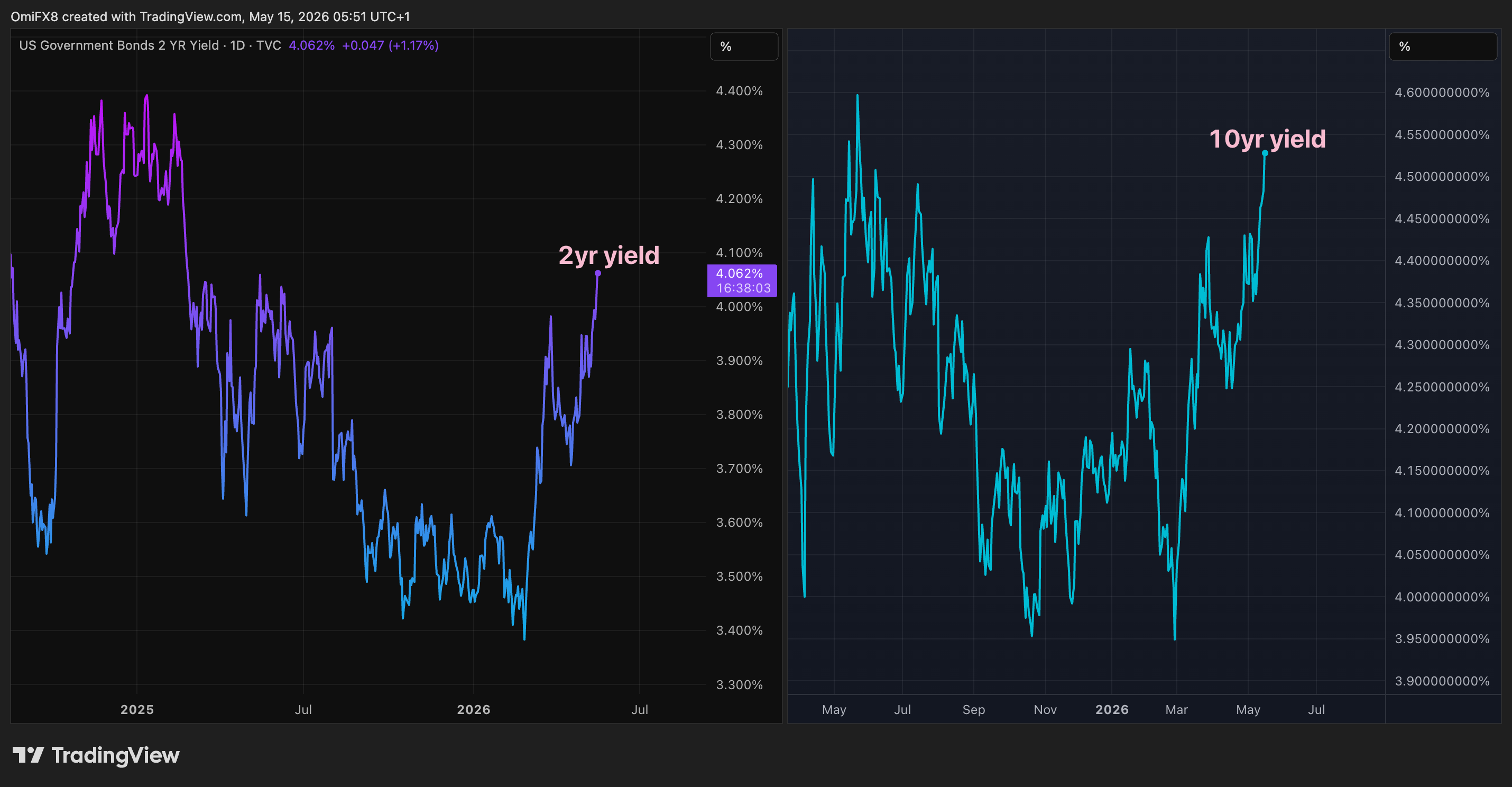
This week?s hotter-than-expected U.S. CPI and PPI reports for April have raised concerns that inflation could remain stubbornly high as rising energy prices and escalating geopolitical tensions linked to the Iran conflict continue to ripple through the global economy.
As inflation fears build, markets are rapidly reassessing the outlook for U.S. monetary policy. With the Fed funds rate currently in the 3.50%?3.75% range, the move in the two-year yield suggests investors are beginning to price in at least one additional 25-basis-point hike.
According to CME?s FedWatch tool, investors are now pricing in more than a 44% probability of a rate hike in December, compared with just 22.5% a week ago. At the start of the year, traders had expected at least two rate cuts before the end of 2026.
The rising bond yields are at odds with President Donald Trump's bias for low rates. Trump has repeatedly argued for much deeper cuts, calling for borrowing costs to fall as low as 1% in an effort to support growth. However, under Chair Jerome Powell, the Federal Reserve has largely resisted political pressure and maintained rates steady at around 3.5%.
To be sure, the Fed has already lowered rates several times over the past three years, bringing the benchmark rate down from around 5% in 2022 to current levels. But those reductions were measured and cautious rather than aggressive.
Attention is now beginning to shift toward the future leadership of the central bank. Trump?s preferred successor, former Fed governor Kevin Warsh, is widely viewed as more open to faster and deeper rate cuts to support economic growth.
For now, however, the bond market is delivering a clear message: expectations of easy money are fading quickly, and investors are once again preparing for the possibility that the Federal Reserve may need to tighten policy rather than loosen it.
Impact on bitcoin
Rising bond yields are increasing the opportunity cost of holding bitcoin.
As U.S. Treasury yields climb, capital allocated to BTC is effectively competing with a risk-free asset that now offers more attractive dollar-denominated returns. Treasuries are not only viewed as a safe haven, but also form a critical pillar of global financial plumbing, widely used as collateral across funding markets and embedded in repo markets, bank balance sheets, and broader liquidity operations.
Against that backdrop, higher Treasury yields act as a natural headwind for bitcoin and other non-yielding assets such as gold.
As of writing, bitcoin is trading near $81,000, largely unchanged on the day, but still below its closely watched 200-day simple moving average just above $82,000. A decisive break above that level would be seen as a potential confirmation of a shift back toward a bullish long-term trend.
Gold, meanwhile, is trading 0.7% lower on the day at $4,614.
In this environment, the tokenized Treasury market stands to benefit as rising yields strengthen demand for on-chain access to high-quality, yield-bearing government debt. The total amount of assets locked in these protocols has hit record highs above $15 billion, according to data source rwa.xyz.

