
 Print
PrintDollar, U.S. Treasury yield market positions may carry glimmer of hope for bitcoin
BY Coindesk | TREASURY | 07:42 AM EDTThe crypto market outlook remains fragile. Rising concerns about Federal Reserve interest-rate increases, a strengthening dollar, higher U.S. Treasury yields, record ETF outflows and airstrikes in the Middle East offer bitcoin (BTC) bulls little reason for optimism.
Yet the market dynamics carry a glimmer of hope.
Bullish positioning, especially in the Dollar Index and interest-rate markets, is beginning to look lopsided. That's the kind of crowded setup that often unwinds with a snap adjustment and a contrarian, counter-trend move. Should that occur, it would probably take the form of a sudden drop in the dollar and yields, which could put a strong floor under bitcon's price.
The crowding shows up clearly in the data. Figures from the CFTC and ICE Europe show the aggregate net long dollar position rose 18% to $34.5 billion in the week ended June 22, the highest in seven years. That's a sharp reversal from the net short position before the Iran conflict began in February.
Rates markets tell a similar story. Leveraged funds' short bets in Secured Overnight Financing Rate (SOFR) futures hit a record 2.97 million contracts. That constitutes over $700 billion in notional bets on rising interest rates, according to Saxo Bank.
While the data show markets are betting heavily that the dollar stays strong and yields elevated, that's exactly what makes the setup fragile.
If oil prices drop and Friday's U.S. jobs data misses estimates, the positioning could unwind quickly. It's the market equivalent of a packed subway car lurching to a stop, where everyone leaning the same way only needs one jolt to send the whole crowd stumbling in the opposite direction.
The result would be dollar weakness and falling yields, the very combination that tends to support risk assets like bitcoin.
For now, BTC remains stuck near $60,000. The candle for the week ended June 28 closed below the 200-week simple moving average for the first time since early 2023. Historically, dips below that long-term average have marked the final phase of bear markets and turned out to be attractive entry points for bulls.
ETFs are on track for a record outflow, having already shed $4 billion this month. That shows just how poor sentiment is right now. Stay alert!
Read more: For analysis of today's activity in altcoins and derivatives, see Crypto Markets Today . For a comprehensive list of events this week, see CoinDesk's "Crypto Week Ahead."
What?s trending
- Oil prices rise as U.S. and Iran reach deal to halt attacks; U.S. crude back above $70 (CNBC): Oil prices rose following an agreement between the U.S. and Iran to halt recent hostilities in the Middle East. West Texas Intermediate futures added nearly 2% to $70.57 per barrel. Brent crude futures gained 1.5% to $73.11.
- South Korea?s $518 billion AI chip push shows crypto is still losing the capital race (CoinDesk): Samsung Electronics
(SSNLF) and SK Hynix are committing about $518 billion to new factories to meet demand for artificial-intelligence chips in a further sign of just how much capital AI is drawing in from everywhere else, crypto included. - Europe?s unlicensed crypto firms face ?wipeout? as MiCA deadline hits (CoinDesk): European cryptocurrency firms that failed to obtain a Markets in Crypto Assets (MiCA) license face a July 1 deadline that could wipe out as many as 80% of them.
- BIS warns stablecoins are more like ETFs than actual money, and they're creating FX risk (CoinDesk): The Bank for International Settlements (BIS) said stablecoins act less like money and more like exchange-traded funds (ETFs), whose units allow traders to gain exposure to a wide range of assets held by the fund.
Today?s signal
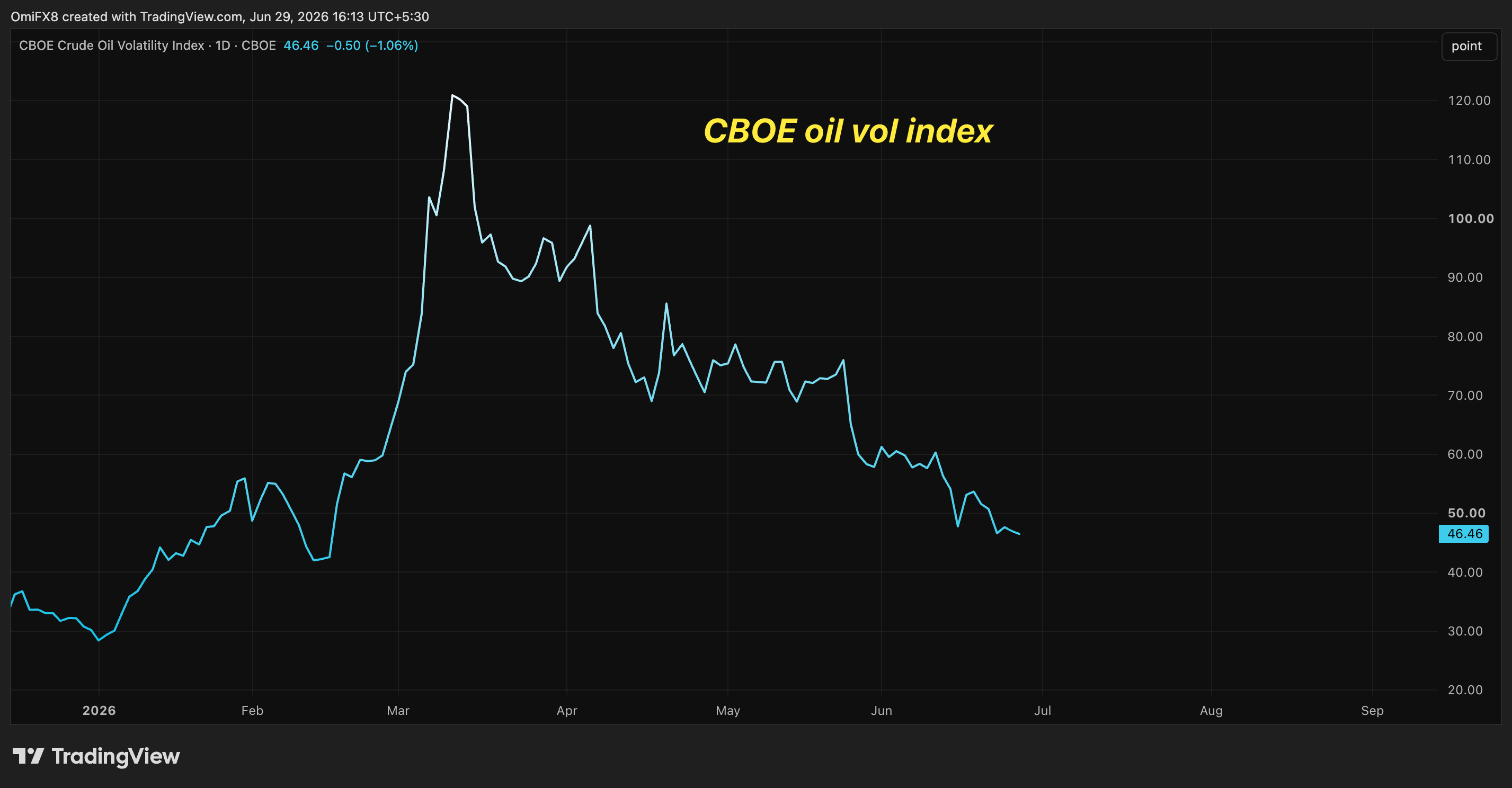
The CBOE crude oil volatility index has slipped to 46%, the lowest since mid-February.
In other words, the risk premium from the Iran war has been priced out of the market. This supports risk-taking in financial markets, including cryptocurrencies.
Still, crude flows through the Strait of Hormuz remain constrained. "Just 8 inbound and 7 outbound crude tankers crossed over the weekend?well below last week?s daily average," geologist Art Berman said on X.
This leaves a persistent tail risk that could quickly push oil volatility higher if supply disruptions intensify.

