
 Print
PrintLive markets: Bitcoin climbs back to $80,800 as U.S. stocks bounce into the close
BY Coindesk | ECONOMIC | 05/12/26 11:04 AM EDT20:03 UTC ? Crypto climbs into the U.S. close as stocks rebound from worst levels
Down nearly 2% at its session low, the Nasdaq narrowed that loss to 0.7% by the day's close. The S&P 500 closed down just 0.15%, and the Dow Jones Industrial Average managed a small gain.
The bounce in traditional markets boosted crypto, with bitcoin (BTC) climbing more than 1% from the day's low to $80,800.
Most crypto-related stocks still closed sharply lower, but a few names managed to move into the green, led by Hut 8's
A number of central bank speakers will be heard from tomorrow following today's disappointing U.S. inflation report. Among them will be Minneapolis Fed President Neel Kashkari and the ECB's Christine Lagarde.
17:32 UTC ? Senate confirms Warsh to Fed board ahead of Chair vote

Bitcoin rose back above $80,000 shortly after the Senate confirmed Kevin Warsh to the Federal Reserve Board, with traders betting his past exposure to crypto investments could lead to a more favorable regulatory stance toward digital assets under a Trump administration.
The Senate is expected to hold a second vote on Wednesday on whether Warsh will formally become Fed chair. If approved, he would immediately take over leadership of the central bank, oversee interest rate policy meetings and help guide the Fed?s approach to inflation, banking oversight and emerging areas such as stablecoins and digital payment systems.
Bitcoin (BTC) bounced to $80,400 from $79,900 following the news, while the broader stock market reversed from their worst levels of the session. The Nasdaq 100 was 1.7% lower, paring some of today's decline.
17:05 UTC ? Crypto stock declines accelerate as bitcoin slips below $80,000
Crypto
Crypto
Data center and AI infrastructure-linked names ? many of them former bitcoin miners ? led declines, with CleanSpark
Meanwhile, the tech-heavy Nasdaq fell over 2%, on track for its worst session since late March. The S&P 500 was 1% lower.
The broad-market weakness also dragged bitcoin (BTC) below the $80,000 level, down roughly 2% over the past 24 hours.
15:28 UTC ? A bitcoin daily close above $82,000 could trigger rally towards $85,000
Bitcoin is trading roughly flat over the past three hours at $80,584, holding above the closely watched $80,000 support level despite a hotter-than-expected U.S. CPI reading.
Matt Mena, senior crypto research strategist at 21Shares, said bitcoin?s resilience near $81,000 signals strong market positioning even as inflation concerns persist. He pointed to several near-term catalysts that could support another move higher, including Thursday?s Senate Banking Committee markup hearing on the CLARITY Act, renewed speculation around a potential U.S. Strategic Bitcoin Reserve announcement, and continued inflows into spot bitcoin ETFs, which have attracted more than $3.5 billion over the past six weeks.
Mena said a daily close above $82,000 could open the door to a rally toward $85,000 and potentially the $88,000-$90,000 range, while failure to break resistance alongside a hotter producer price index reading could send bitcoin back toward $75,000 support.
15:10 UTC ? The copper-gold ratio is breaking out
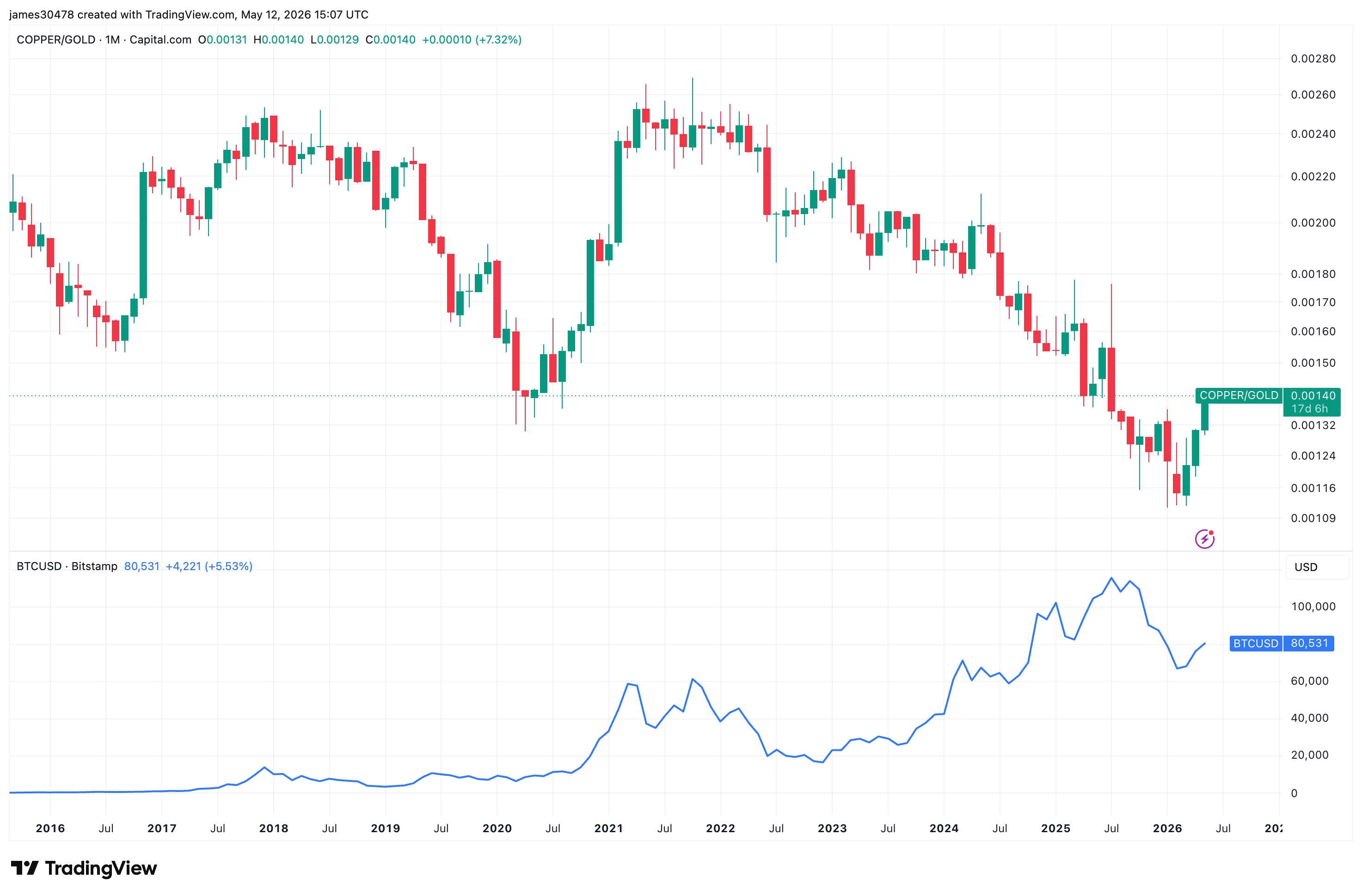
Copper, a reliable economic indicator, is nearing record highs at $6.54.
Historically, bitcoin and copper have shown strong positive correlations, with copper rallies often preceding gains in bitcoin.
Bitcoin?s strongest rallies have also tended to coincide with a rising copper/gold ratio, which has now reached its highest level since July 2025 at 0.00140. While the ratio has broken above its 200-day moving average, an asset that rises above its 200-day moving average is generally considered to be in a long-term uptrend.
15:05 UTC ? Bitcoin flat following disappointing inflation data
Core consumer prices ? which would have stripped out what everyone already knew were surging energy costs ? rose 0.4% in April, double March's 0.2% pace and higher than 0.3% expected by economists.
On a year-over-year basis, core CPI rose 2.8% versus 2.6% in March and 2.7% forecast.
Headline CPI ? which does include energy costs ? was higher by 3.8% in April versus just 3.3% in March and 3,7% expected. That 3.8% was the fastest pace of inflation since May 2023.
The data has market participants quickly pricing in Federal Reserve rate hikes ??a massive change from weeks ago, when the question was how often the Fed would be cutting rates in 2026.
According to CME FedWatch, markets are seeing more than a 35% chance of one or more rate hikes this year.
The news has helped send stocks lower, led by the Nasdaq's 1.3% decline.
Bitcoin (BTC), though, has been holding steady, currently trading at $80,500, roughly flat over the past 24 hours. Major altcoins like ether (ETH) and XRP (XRP) are down closer to 2.5%.

